
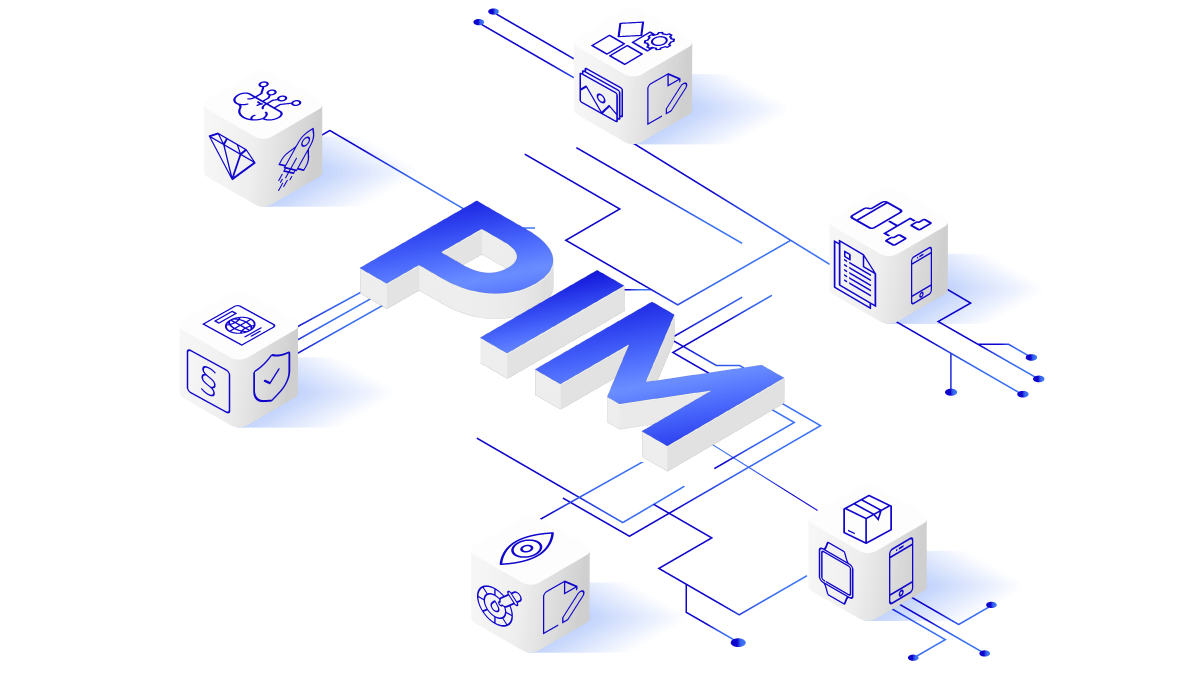
 Product Information Management
Product Information Management (PIM) is a system that centralises, enriches, and distributes product data such as descriptions, images, specifications, and pricing across every sales channel from one platform. Retailers, manufacturers, and B2B teams use PIM to keep product information accurate and consistent whether it appears on a website, marketplace, app, or printed catalogue.
In this guide, you'll learn what is PIM product information management, how PIM software works, and why it is critical for e-commerce success.
What Does "PIM" Stand For?
PIM stands for Product Information Management. It refers to both the discipline of managing product data and the software category built to do it. Bluestone PIM is one example: a headless, agent-first product data platform where AI agents handle onboarding, enrichment and validation, and people set the brief and govern the result.
What Is Product Information Management?
Product Information Management (PIM) is the process of centrally organising and maintaining all product data (descriptions, images, technical specifications, pricing, and more) in one digital platform.
PIM is important for e-commerce because it ensures product data remains accurate, consistent, and ready for publication across multiple sales channels.
Download free e-book
Complete Guide to PIM
This free guide walks you through everything you need to know about modern Product Information Management (PIM) and how to use it as a foundation for growth.
Online retailers rarely sell products through a single platform anymore. A typical commerce stack includes:
-
e-commerce platforms
-
marketplaces
-
social commerce
-
printed catalogues
-
retail POS systems
Each channel requires structured product data with different attributes and formats.
Bluestone PIM solves this by centralising product information and letting AI agents keep it current across every channel. Instead of updating descriptions, attributes and images manually in each system, teams set the rules once and the agents publish everywhere.
For growing e-commerce businesses, this approach removes spreadsheet chaos and prevents inconsistent product listings that damage trust and conversions.
Data Sources
Supplier
ERP
DPP
Assets
Excel / CSV
Industry Database
↓
Middle Layer
AI-Powered Product Management
Bluestone PIM
- Product Completeness Score (QA)
- Digital Asset Management (DAM)
- Product enrichment process
- AI enrich and translate
Extensibility
- Extensions Hub
- Connectors
- Packaged Business Capabilities
↓
Middle Layer
Output
E-commerce / CMS
Resellers
AI Support Agents
What Is a PIM System?
A PIM system is software that centralises, enriches, and distributes product information across commerce channels, connecting internal systems with the platforms where customers discover and buy products. Platforms such as Bluestone PIM act as this bridge. Product data moves from internal sources to every sales channel without manual re-entry.
Typical integrations include:
-
ERP systems for operational data
-
supplier feeds and spreadsheets
-
digital asset libraries (PIM with DAM integration)
-
e-commerce platforms and marketplaces
Once data enters the PIM platform, teams enrich product attributes, images, and descriptions before distributing them across channels.
Which PIM Providers Should You Consider?
Popular PIM vendors include:
Among these options, Bluestone PIM stands out because it is headless by design and agent first by architecture: every function sits behind a task-level API, so AI agents can do the daily work of enrichment, validation and publishing while people govern the result. It also holds MACH certification, so it fits into a composable stack without a rebuild.
Not sure which vendor fits your stack? See our detailed comparisons: how Bluestone PIM compares to Akeneo and Inriver alternative comparison.
What Are the Main Components of a PIM Solution?
The main components of a PIM solution include product data management, enrichment workflows, digital asset management, data governance, and omnichannel data distribution.
A Product Information Management system does far more than store product attributes. It acts as the operational hub for product content across e-commerce platforms, marketplaces, catalogues, and partner systems.
Platforms such as Bluestone PIM combine several capabilities that allow businesses to manage complex product catalogues efficiently and keep product data consistent across every channel.
Key components include:
Product Data Centralisation
By consolidating this information into one system, businesses stop duplicate records and conflicting attributes from reaching customers. Bluestone PIM imports product data from multiple sources through its API and structures it into flexible product models that support complex catalogues, variants and category hierarchies, ready for AI agents to enrich.
Product Data Enrichment
Product data enrichment is the process of improving product information by adding attributes, descriptions, images, translations, and marketing content.
Raw product data often arrives incomplete or inconsistent. PIM workflows allow teams to refine and expand this information before products are published.
Common enrichment activities include:
-
adding detailed product specifications
-
writing SEO-friendly descriptions
-
attaching images and videos
-
adding localisation and translations
-
assigning categories and product relationships
Bluestone PIM's AI agents do this enrichment work directly: they generate product descriptions, analyse product images, extract attributes and produce multilingual content, so the team reviews and approves rather than writing from scratch.

Download free e-book
AI Visibility Guide for Retailers
Learn how to structure product data so AI can find, cite, and recommend your products. Covers GEO, agentic commerce, and 30+ data fields.
Digital Asset Management
Product content is not limited to text and attributes. Images, videos, documents, and certifications are essential for presenting products effectively online.
The best PIM solutions include Digital Asset Management (DAM) capabilities that organise these files and connect them to the correct products.
A PIM with integrated asset management allows teams to:
-
store images and videos in a central library
-
manage product manuals and certificates
-
maintain version history for assets
-
link media files directly to product records
In Bluestone PIM, teams attach digital assets directly to products and variants, so every sales channel receives the correct visual content automatically.
See how Digital Asset Management (DAM) works inside Bluestone PIM.
Data Governance and Quality Control
Product data quality determines whether product listings are reliable and complete.
PIM systems include governance tools that help teams maintain data accuracy across large catalogues. These tools monitor completeness, enforce validation rules, and track changes to product data.
Key governance features typically include:
-
data validation rules
-
completeness scoring
-
role-based permissions
-
change history and audit logs
These capabilities help businesses prevent incomplete product listings from reaching customers. In Bluestone PIM, completeness dashboards and validation workflows allow teams to monitor product readiness before publishing.
Watch the video and learn how to enhance data quality with AI-powered tool in Bluestone PIM.
Workflow and Collaboration
Managing product information involves multiple teams across the organisation.
Marketing teams create descriptions, product managers manage specifications, and IT teams maintain integrations. Without a structured workflow, collaboration becomes chaotic.
PIM systems provide workflow tools that organise how product data is created and approved.
Typical workflow capabilities include:
-
task assignment
-
approval processes
-
supplier collaboration
-
role-based access control
Bluestone PIM includes built-in collaboration tools that allow internal teams and external partners to contribute product data while maintaining strict access control.
Omnichannel Data Distribution
Omnichannel distribution ensures that product information reaches every sales channel automatically.
Once product data is complete, the PIM platform distributes it to connected systems such as:
-
e-commerce platforms
-
marketplaces
-
marketing platforms
-
mobile apps
-
print catalogues
This process is often called product data syndication.
Bluestone PIM keeps product data synchronised across every platform in real time through its API. Fewer errors reach customers, and new products reach the shelf faster.
What Is PIM in E-Commerce Compared to ERP, DAM, and CMS?
Choosing the right tool for managing your product information can be challenging, especially with so many options available. Each tool has its strengths and limitations. A thorough PIM selection process is crucial to ensure the best fit for your business needs and effective management of product data. Understanding where PIM stands out can help you make an informed decision.
Below, we compare PIM with other commonly used tools to highlight how it addresses specific business needs.
PIM vs Excel
While Excel works for small-scale tasks, it struggles as businesses grow, especially with managing product information. As your product catalogue expands, spreadsheets lacks the scalability to handle large data volumes, automation for efficiency, and data governance to ensure consistency and accuracy across channels.
PIM vs ERP
Enterprise Resource Planning (ERP) systems manage operational data such as inventory and finances, and often include project management and customer segments functionalities, but they don’t handle enriched product content or its distribution. PIM complements ERP by centralising and enriching product information, ensuring accuracy and consistency, and enabling efficient distribution across multiple channels. Together, they streamline operations and enhance the customer experience.
Watch the video to learn how to integrate ERP system with PIM.
PIM vs DAM
Digital Asset Management (DAM) systems are excellent for managing digital assets like images and videos; however, they do not provide the tools needed to manage product attributes, categories, or data distribution. For businesses seeking a more unified solution, a PIM with integrated DAM functions combines the best of both worlds to offer you centralised control of your product data and digital assets together.
PIM vs CMS
Content Management Systems (CMS) are designed for managing website content, not product data. PIM ensures that all product details are accurate and ready for use across various CMS platforms, maintaining consistency across digital channels.
PIM vs MDM
Master Data Management (MDM) systems focus on managing core business data, and MDM and product lifecycle management (PLM) systems may also address supply chain and product lifecycle needs, but do not offer the enrichment, localisation, or distribution capabilities of PIM. PIM systems specialise in optimising product data specifically for sales and marketing purposes.
| System | Main Purpose |
|---|---|
| ERP | Operational data such as inventory, pricing, and orders |
| DAM | Storage and management of digital assets |
| CMS | Website and editorial content |
| PIM | Product information used for selling products |
What Are the Benefits of PIM?
A PIM platform helps manage product data more efficiently. In addition to improving data quality, PIM plays a key role in enhancing customer experience by ensuring data consistency and reducing errors, which leads to higher customer satisfaction. It also enables businesses to quickly adapt to evolving market trends, helping them stay competitive in the digital marketplace.
Below are a few ways it can make a positive impact.
In a study we conducted with Ventana Research, we found that 74% of the companies surveyed want to use a PIM solution primarily to avoid data errors and mistakes.
But the benefits of PIM go beyond improving data quality! Let's explore the other key advantages that companies can unlock through the implementation of a PIM solution.
1 / Consistent Customer Experience
PIM ensures product information is accurate and uniform across online stores, apps, and physical locations, building trust and loyalty. This consistency fosters customer loyalty and improves customer experiences across all touchpoints.
For instance, a furniture retailer using PIM can ensure that a sofa’s dimensions, materials, and care instructions are identical on the website, in catalogues, and on in-store tags. This consistency helps customers make informed decisions, reducing returns and increasing satisfaction.
2 / Fewer Data Entry Mistakes
Storing all data in one location reduces the risk of outdated prices or contradictory descriptions. Incoming product details are categorised, duplicates are eliminated, and updated content is accurately organised. It helps prevent anyone using out-of-date information when coming up with deals or listing products that are no longer offered by the company.
3 / Omnichannel Engagement
Businesses around the world are going omnichannel and engaging customers across multiple channels throughout their entire shopping journey.
By supporting an omnichannel marketing strategy, a PIM ensures consistency across all marketing channels, making it easier to deliver a unified brand experience.
This can often be challenging due to the need for consistent and tailor content at all customer touchpoints. A PIM solution addresses this by organising both digital and physical product content, enabling teams to assign the right images, videos, and descriptions to each catalogue and campaign.
4 / Time Saved with Automation
Routine administrative tasks, such as updating product listings across multiple channels, can be managed automatically, as automated workflows streamline these processes. This puts an end to the need for manually updating thousands of item entries in an online store.
5 / Faster Time-to-Market
Centralising information speeds up the process of releasing new lines or variants, since every team member uses the same data. This shared data, including readily available and accurate specifications, pricing, and marketing assets, enables companies to quickly adapt their products and launch new lines faster than competitors using disparate data, allowing them to rapidly enter new sales channels.
6 / Stronger Sales
Clear, accurate product details boost sales by building customer confidence, and a PIM system helps an ecommerce business sell products more effectively by centralising and managing product data for all sales channels.
Comprehensive information, from detailed specs and high-quality images to accurate pricing, empowers shoppers. Accurate information also minimises returns and customer service queries, saving time and resources while improving customer satisfaction and loyalty.
Checklist: 5 Signs You Need PIM
Answer the questions below to figure out if it’s time to get a PIM system:
 Do you manage a large catalogue with thousands of products (such as product catalogues or print catalogues) ?
Is your team overwhelmed by updating data manually?
Are customers noticing mismatched or outdated descriptions?
Are you expanding to new markets or sales channels?
Do you struggle to localise product information effectively across regions?
If you answered “yes” to any of these, consider opting for PIM to streamline your operations and improve your results.
But if you still have any doubts, why not reach out to our advisors for a free, no-obligation consultation? They are here to provide the answers to your questions and point you in the right direction.

Download free e-book
5 Signs You Need a PIM System
Stop guessing. See the red flags teams miss until product data starts slowing growth. A quick, practical guide for e-commerce, marketing, and product teams.
How to Get Started with PIM
Implementing new technology can be challenging, but dividing the process into manageable steps helps ensure a seamless transition. Focusing on specific needs and setting clear goals allows you to successfully implement a PIM solution that revolutionises the way you manage product data. Additionally, evaluating different product information management solutions is essential to find the best fit for your organization.
-
Assess your needs: identify pain points, such as manual processes or data inconsistencies.
-
Choose a solution: select a PIM system that integrates with your tech stack and supports your growth goals, ensuring compatibility with external systems such as suppliers, ERPs, and other third-party platforms.
-
Plan implementation: define workflows, set quality standards, and onboard teams.
-
Measure success: track improvements in efficiency, data accuracy, and time-to-market.
Once you've identified the key features of a PIM solution, the next step is to create a Request for Proposal (RFP) and send it to potential PIM providers. This RFP will help you outline your requirements, expectations, and criteria so that you can proceed more efficiently when selecting a provider.
To help you get started, you can download our free, customizable RFP template, which already includes 70 key questions, and tailor it to your company's needs.
Why Choose Bluestone PIM?
Managing product information across multiple systems and sales channels gets complicated fast. Bluestone PIM is the headless, agent-first product data platform: every function sits behind a task-level API, so AI agents can do the daily work of enrichment, validation and publishing while your team sets the brief and governs the result.
Here’s what makes Bluestone PIM stand out.
A System That Grows With Your Business
A headless PIM holds all product truth in one core, with no fixed interface built on top of it. Every screen or agent that connects to it is simply a "head," reaching in through the same APIs.
Headless doesn't mean there's no UI. Bluestone PIM ships a full one, but that UI is just one head among many. It isn't the cage the data lives inside. No interface, not even Bluestone PIM's own, gets closer to the data than any other does. That's exactly why Bluestone PIM is the only major enterprise PIM with full UI/API parity: the API running its own interface is the same one customers and AI agents call, so 100% of development goes into the API surface, not into a UI layer competitors end up maintaining twice.
Which means Bluestone PIM grows with the business instead of against it. Add a channel, expand the catalogue: neither forces a rebuild.
MACH certification and composable architecture come standard, so Bluestone PIM fits straight into a stack that already runs other best-of-breed tools.
Considering other PIM providers? See how Bluestone PIM compares to Akeneo, inRiver, Pimberly, Struct and Sales Layer.
Every Integration Runs Through One API Layer
The API behind Bluestone PIM wasn't built to hand off a data export once a day. It was built for someone to create a full interface on top of it: granular enough to update a single price, fast enough to read in real time. It checks who's asking too, so access stays controlled down to the user.
With 700+ task-level endpoints, that's what makes an AI agent as capable as a developer. Update pricing on commercetools. Push a new listing live on Shopify. Everything else, from Google Shopping feeds to social commerce, runs through the same set of calls.
Since Q4 2025, every one of those endpoints is also live as an MCP tool. Bring Claude, ChatGPT or your own model. None of them need a custom integration built first.
Teams update product information once. Every connected channel gets it automatically.
AI Agents That Do the Enrichment Work
Writing a product description and checking it against a spec sheet used to take someone the better part of an afternoon, per product. In Bluestone PIM, an agent runs that pass in minutes. A person checks it before it goes live.
In practice, that means catching a missing weight or a spec that contradicts the photo before a customer does, not after a return comes back. It means a description and a first draft of the multilingual copy exist the moment a product enters the system, so nobody starts from a blank page. And when that copy has already gone live in ten languages, a new update gets checked against every one of them, so a translated version doesn't quietly drift from what the original said.
Bluestone PIM does this through AI Analyst, AI Enrich and AI Linguist, working directly inside the platform. None of it runs unsupervised. Agents do the repetitive pass. People decide what actually ships.
Watch our video for an overview of the features.
Collaboration Built for Product Teams
Product information involves multiple teams across the organisation. Bluestone PIM supports collaboration through role-based workflows, task management, and in-app communication.
Marketing, product, and IT teams can work together in one system while maintaining control over permissions and approval processes.
Continuous Improvement and Expert Support
Bluestone PIM evolves through regular updates based on customer feedback and market developments. Businesses benefit from new capabilities without disruptive upgrade projects.
From implementation to daily operations, the Bluestone team works closely with customers to ensure the platform supports their product data strategy.
What Customers Say about Bluestone PIM

We evaluated many PIM solutions and selected Bluestone PIM based on its easy user interface, advanced data modeling, and modern application programming interface. SaaS delivery made the choice even easier. We have integrated Bluestone PIM with our content management system Sitcore, and it all works very smoothly. Bluestone PIM has proven to be a solid partner and enabled us to increase our digital business volume dramatically.
Start Simplifying Your Product Data Management
Disorganised product data slows e-commerce growth, whether that's a missing spec holding up a launch or a return caused by a description that didn't match what shipped.
Bluestone PIM is the headless, agent-first product data platform: the catalogue is the asset, and AI agents keep it accurate everywhere it needs to be, from your website to whatever an AI shopping agent reads next. People still decide what ships.
If you want to see how it works in practice, talk with a Bluestone PIM expert or book a demo to explore how the platform can support your product data strategy.
![How To Scale SKU-Heavy Catalogues Without Duplication [Guide For Retailers]](https://www.bluestonepim.com/hubfs/How-To-Scale-SKU-Heavy-Catalogues-Without-Duplication-1.png)